

In the increasingly entangled digital ecosystems of the ~NU relations universe, even teddies and cats—those seemingly serene archetypes of comfort and independence—are not immune to cognitive overload. While this concept has been widely studied in humans, especially in cognitive psychology and the psychology of labor, applying it to fictional beings exposes the mechanism with unusual clarity. Cognitive overload occurs when the volume or complexity of incoming information surpasses the processing capacity of a system. For living workers, this often manifests as burnout, error-prone performance, or decision paralysis. For teddies and cats, it emerges in delightfully peculiar yet metaphorically revealing ways.

At the core of overload lies limited working memory, a principle established by Miller’s research on short-term capacity and later refined in cognitive load theory. Whether human, teddy, or cat, the “attentional budget” remains finite. Continuous scrolling—especially when content becomes recursive, referencing itself, responding to its own aesthetics, or spawning derivatives—creates an ever-thickening cognitive fog. This is amplified by several known factors: the switch-cost effect (changing topic too often increases processing load), semantic interference (similar yet slightly varied content becomes hard to differentiate), and decision fatigue (the more micro-choices you make, the harder subsequent ones become).
In digital work environments, psychology-of-labor research shows that constant interruptions degrade task performance and subjective well-being. Replace “interruptions” with a self-updating, auto-generating ~NU relations feed that teddies and cats compulsively browse, and you have a potent recipe for delightful dysfunction.
Here are four illustrative examples:

1. The Teddy Monitoring Workshop Dashboards
A mint-green-suited teddy tries to analyze workshop telemetry data posted in the ~NU relations feed: antenna harmonics, plush-fiber stress curves, and daily mood-gloss reports. The dashboard tiles keep auto-shuffling because other teddies keep commenting on them. The teddy’s working memory collapses under the combination of technical graphs and emotional metadata. Symptoms: misreading “Plush Tension Index” as “Plus Attention Index,” leading to unnecessary self-improvement routines.
2. The Cat Lost in Aesthetic Recursion
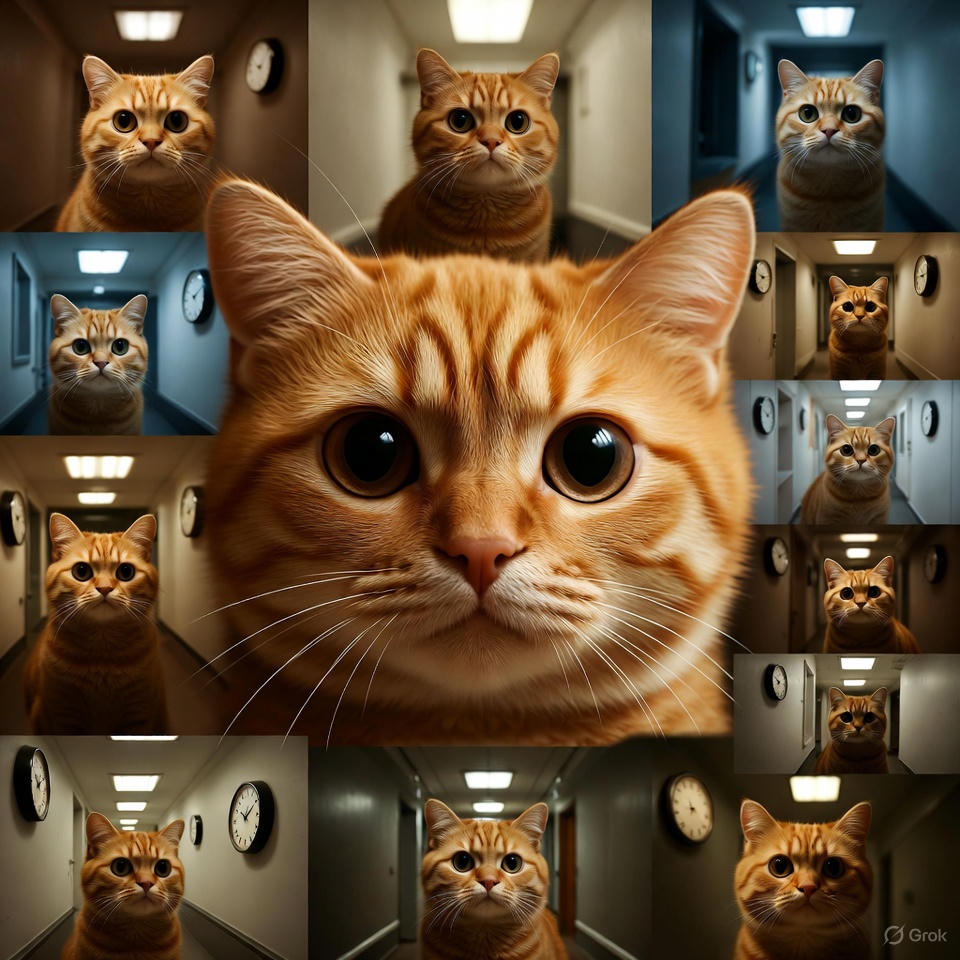
An orange anthropomorphic cat scrolls through endless images of itself rendered in slightly different corridors of blinking clocks. Each version has subtle stylistic variations—more blur, fewer clocks, slightly altered whisker gloss. The cat’s perceptual system experiences semantic interference: all corridor-clock compositions start blending into one conceptual hairball. The recursive loop—cat viewing content derived from previous content—creates a spiraling overload. The cat eventually curls into a ball, believing the clocks now blink inside its own mind.
3. The Teddy Consuming Motivational Video Clips
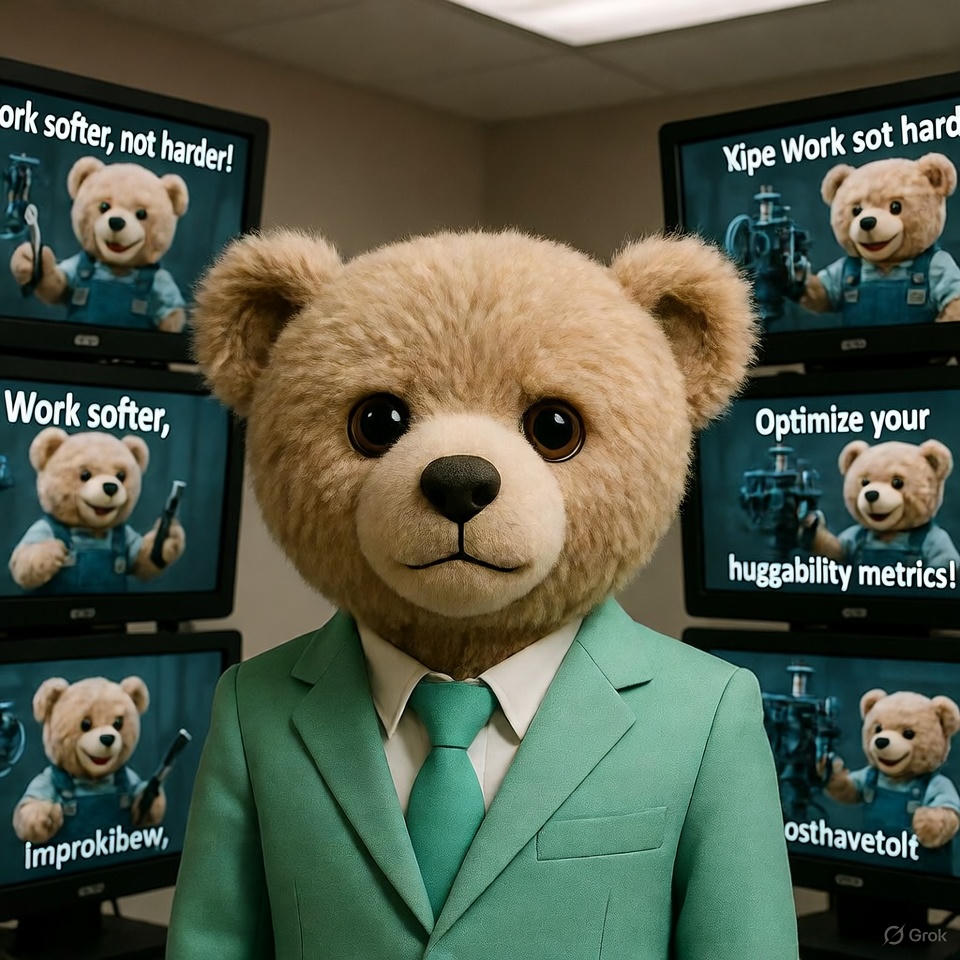
To increase production morale, the feed recommends a chain of motivational micro-videos starring other teddies repairing antenna arrays with improbable happiness. According to psychology-of-labor findings, workers experiencing pressure to maintain positivity show increased cognitive strain. The teddy tries to imitate these behaviors but, overwhelmed by contradictory tips (“Work softer, not harder!” “Optimize your huggability metrics!”), enters a state of emotional decision fatigue. Eventually it pauses the feed and stares blankly at a ceiling light, which thankfully offers no auto-play.
4. The Cat Managing Multitier Notification Threads
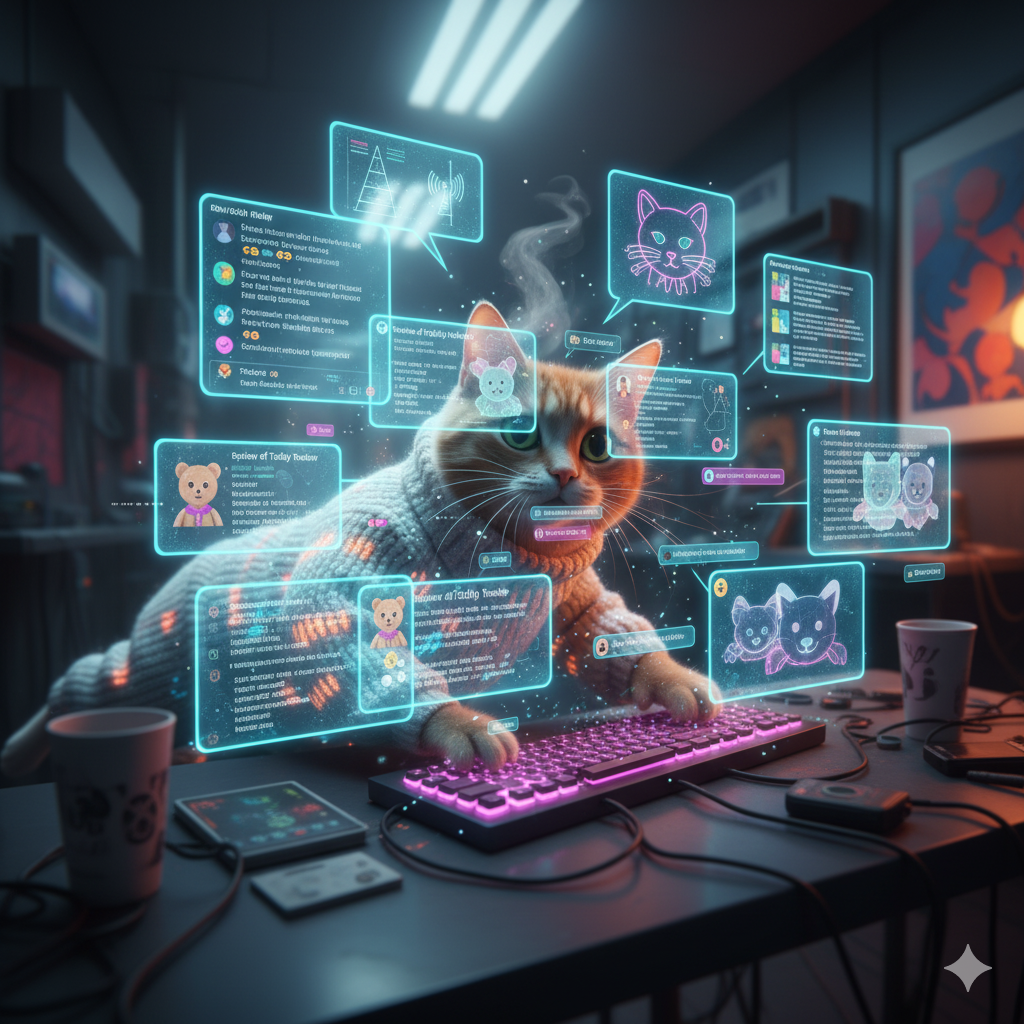
A multitasking cat attempts to respond to comments on its own review of a teddy’s review of another cat’s video of antenna-generated plush projections. The nested chain of meta-responses becomes a recursion trap: every ping opens three more sub-threads. Cognitive psychology warns that multitasking is largely an illusion—each switch costs time and processing energy. After 47 switches in under two minutes, the cat accidentally replies “meow” to a technical schematic and “voltage spike at 3.2 kHz” to a fan-art post.
Across these examples, the mechanism is clear: recursive feeds compress, blend, and multiply demands on attention. Teddies attempt to troubleshoot their own emotional ergonomics; cats try to process infinite variations of themselves within their own media loop. The result—whether plush confusion or feline existential blinking—mirrors real cognitive overload in human digital environments.
In the world of ~NU relations, recognizing overload is the first step toward resisting the algorithmic labyrinth. Even teddies and cats must sometimes log off, breathe, and let the antennas hum without interpretation.


 🟨🟩🟦 ~NU relations
Leave a comment