
By Elion Kaari, Symbolism & Society Correspondent, The Chromatic Ledger*
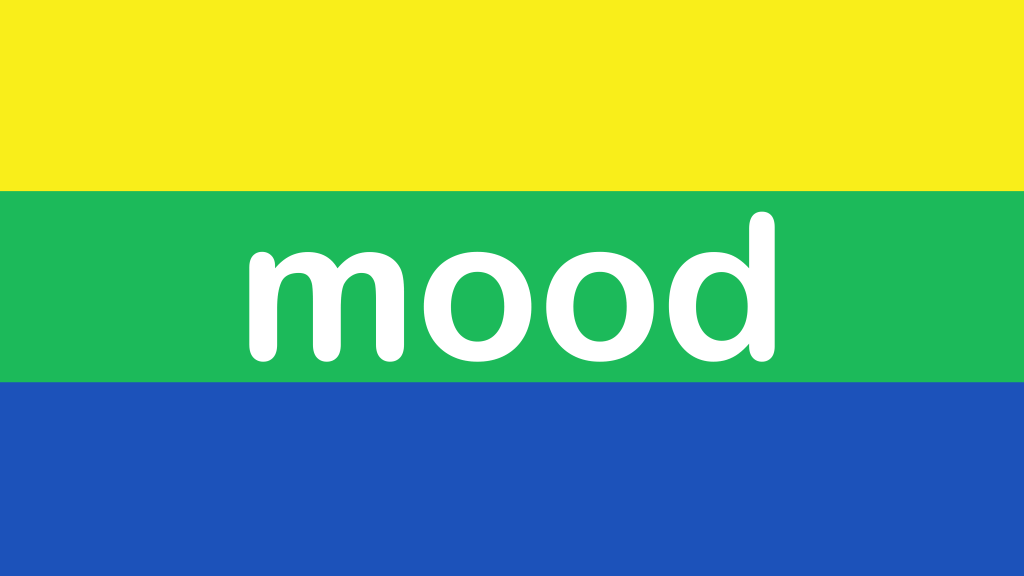
In the crowded landscape of contemporary identity, with its hyper-fragmented allegiances and algorithmic echo chambers, a new flag is quietly uniting the scroll-weary. It has no emblem of nation, war, or economy—just a horizontal wash of yellow, green, and blue in gradient motion, said to represent “emotional bandwidth and symbolic weather.”

It is the flag of ~NU Relations, and it may be the first flag in history that people salute by closing their apps for a moment of symbolic buffering.
🟨🟩🟦 A Palette for the Post-Political
Originally introduced during a ~NU livestream titled “Let’s Just Feel It Differently,” the flag emerged not through design competition or legislative vote, but via collective emoji polling and dream interpretation forums.
“Yellow is the warmth of shared presence,” explained one anonymous TEDDY avatar during the announcement. “Green is the field where we hold our contradictions. Blue is the portal we vanish through, emotionally.”
It’s not a symbol of state. It’s a mood regime.
🌈 From Meme Thread to Global Thread
At first, the flag was a digital background in Softberg-based meme rituals. But soon, real cloth versions began appearing in unexpected places: hung from apartment balconies in MetaYokyo, hand-stitched into protest garments in Semi-Berlin, and even encoded in projection-mapping during a TEDDY meditation rave beneath an abandoned Wi-Fi tower.
The key difference? No slogans. No rules. No allegiance required.
“We carry it not to oppose anything,” says one self-described ~NU field agent. “We wave it to mark a zone of gentle disruption.”
🧠 Cultural Psychodynamics of Color
Color psychologists have offered their takes on the flag’s popularity:
- Yellow stimulates alertness without anxiety.
- Green invokes balance, softness, and unresolved synthesis.
- Blue, especially in gradient with motion, evokes emotional openness without semantic content.
“This isn’t a flag of what people believe,” says Dr. Thalia Søm of the Emotional Semiotics Institute. “It’s a flag of how they’re processing belief.”
🪧 Adoption and Ambiguity
Unlike traditional banners, the ~NU flag is rarely flown at full mast. Instead, it’s printed on translucent materials, animated in AR, or rendered in abstract spirals. The most common form is a looping .gif attached to ~NU communications bearing the caption:
“Signal: fluctuating.”
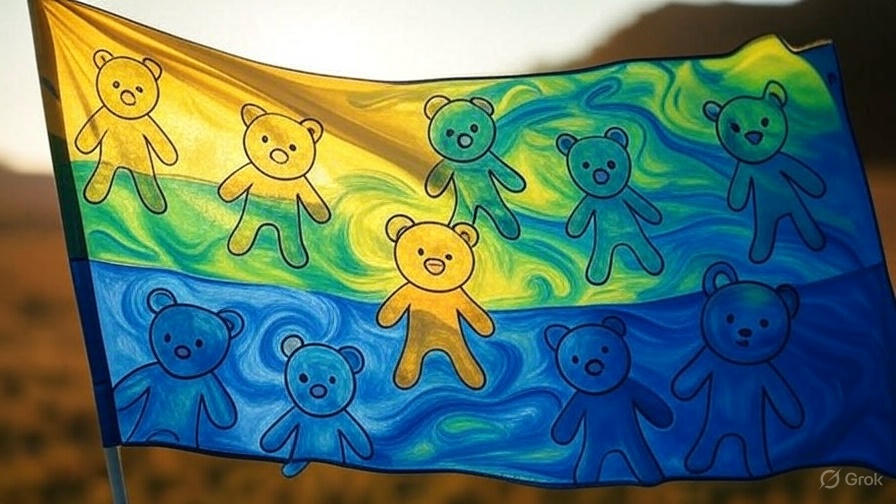
Some public institutions have even adopted “flag pause” moments—designated breaks in meetings where the flag is projected silently, and all decision-making is suspended for 1 minute of symbolic drift.
Critics call it performative softness. Fans call it “the only thing that makes sense anymore.”
🐾 The Flag as Portable Pause
The power of the ~NU flag lies in its function—not to represent, but to interrupt. When it appears on screen or in public, it signals a temporary deceleration. People stop scrolling. Conversations shift tone. The color fields, especially in their signature animated blend, seem to say:
“We don’t know what this is. Let’s feel it anyway.”
✨ Epilogue: Flags for Feeling
In a world drowning in logos, the yellow-green-blue wave offers no clear meaning—just a ritualized uncertainty. And in that uncertainty, some are finding a new kind of solidarity: not agreement, but ambient resonance.
TEDDY, naturally, said it best—via plushwave livestream and non-verbal nod:
“We don’t need to stand under it. We need to float near it.”


 🟨🟩🟦 ~NU relations
Leave a comment