
By Arlo Venn, Political Semiotics Columnist, Civic Media Weekly
In an age where voters scroll more than they vote and public trust is one trending GIF away from implosion, a peculiar new icon is rising—not from the ranks of party politics or grassroots activism, but from the uncanny valley of post-ironic plush.
It’s 🐻 TEDDY, the soft-eyed mascot of the ~NU relations movement, and his round, contemplative face is currently plastered across public billboards from MetaYokyo to Alt-Vienna with the slogan:
“Trust is a texture.”
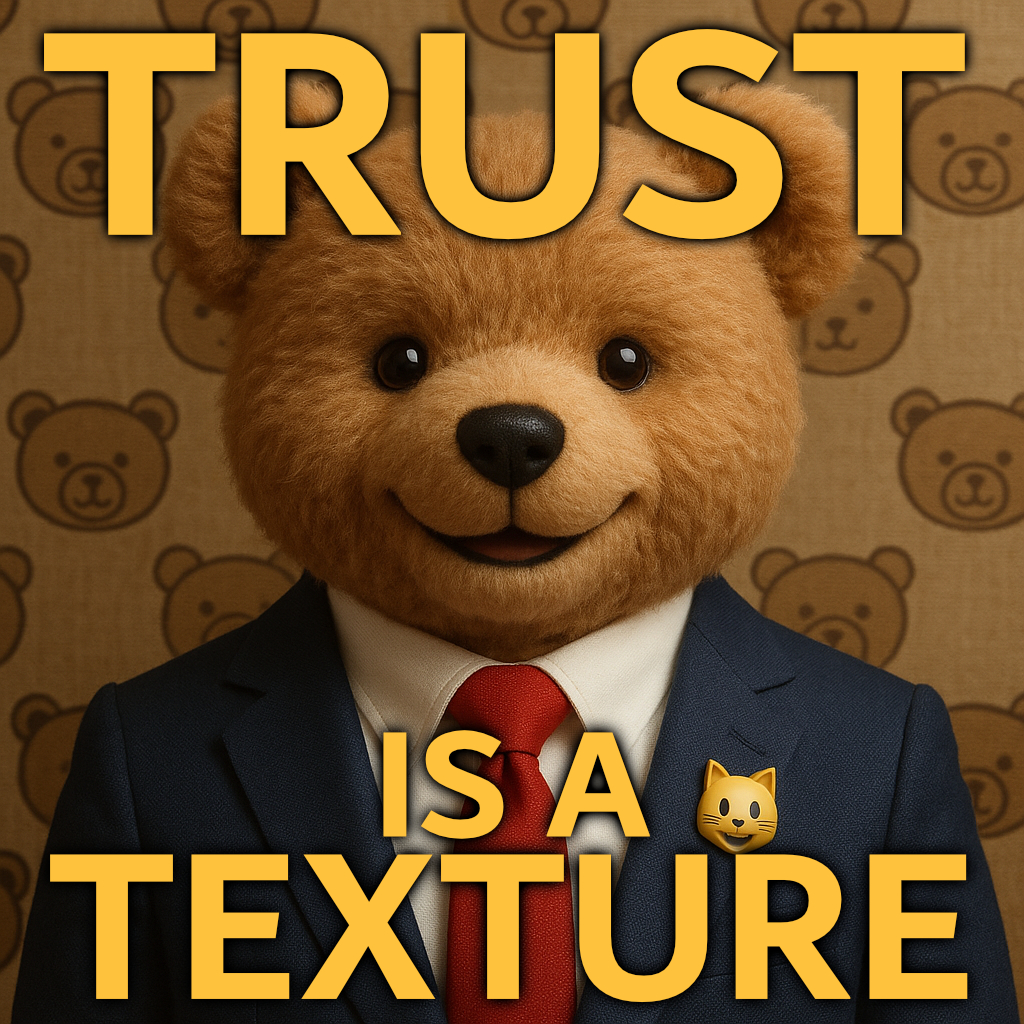
No policy promises. No fine print. Just TEDDY staring out at rush hour traffic as if to say: “Everything might be okay, if you squint with your soul.”
And surprisingly, it’s working.
🗳️ The Polls Don’t Lie—Even If Politicians Might
Recent surveys by the Soft Metrics Institute reveal a 24% increase in perceived trustworthiness when TEDDY is shown in civic advertising instead of real-life candidates. In some microstates, ~NU-branded visuals have replaced mayoral photos on city websites “for emotional calibration purposes.”
At a recent forum on “Symbolic Governance,” a delegate from the Baltoscandia Civic Union asked openly:
“If people feel better seeing TEDDY, isn’t that its own form of public service?”
🧸 TEDDY’s Appeal: A New Kind of Leadership?
TEDDY doesn’t talk. He blinks. He doesn’t debate. He emits warm affirmations like:
“Systems are just feelings with syntax.”
This passive, plush-like presence provides relief in a world saturated with performative charisma and algorithmic outrage. Citizens report “lower blood pressure and increased clarity” after viewing TEDDY’s daily message feed—currently curated by a community council in Softberg known as the “Fluff Bureau.”
In one viral moment, TEDDY replaced a political scandal headline in a commuter news app with the simple phrase:
“You are not the glitch. The world is buffering.”
🐾 The Political Implications of Plush Logic
Experts argue that TEDDY’s rise marks the emergence of a post-verbal politics—where symbolic consistency matters more than legislative detail.
“TEDDY is the anti-politician,” says Dr. Elena Rauter of the Center for Emotional Governance. “He absorbs projection. He doesn’t provoke it. In today’s media landscape, that’s revolutionary.”
This phenomenon has been called “the Plush Effect,” a term describing how citizens in high-noise information environments are more likely to engage with emotionally neutral, comfort-coded figures. TEDDY, by virtue of being fictional and fuzzy, carries no scandal—only vibe stability.
😾 But Where’s the Accountability?
Critics argue that replacing complex democratic discourse with a soft, blinking bear is a slippery slope to political sedation.
“Teddyfication is a dangerous coping mechanism,” warns political theorist Miko Ibarra. “It displaces real civic engagement with aesthetic catharsis. It’s governance by ambient reassurance.”
Even some former ~NU insiders are voicing concern. One anonymous source posted:
“TEDDY was meant to hold space for softness, not replace substance. Now he’s being used to silence discontent with emotional UX.”
🎭 The Movement Responds
At a recent virtual town hall held in a “temple of ambient transparency” (essentially, a livestream of TEDDY floating in a cube of symbolic fog), the ~NU response was characteristically cryptic:
“TEDDY is not your leader. TEDDY is your plush projection. Breathe accordingly.”
The movement insists that the real agenda lies not in controlling politics, but in “reconfiguring emotional expectations around power.” Or, as 🐱 CAT put it in a recent meme:
“Why elect when you can reflect?”
🧵 Final Thoughts
Whether it’s a meme, a mood, or the future of participatory democracy, TEDDY’s steady rise into public visibility marks a turning point in how civic symbols operate. In a world overwhelmed by noise, TEDDY doesn’t promise change. He offers softness you can scroll to.
And maybe, just maybe, that’s enough to win your vote.


 🟨🟩🟦 ~NU relations
Leave a comment