

By Dr. Áine Lorentz & Dr. Koji Amano, Institute for Cybernetic Affect Studies, Intercontinental Academy of Soft Technologies (ICAST)
Abstract
This essay explores the emotional infrastructure of the ~NU relations movement, focusing on how emotionally coded rituals, mediated by the symbolic figures 🐻 TEDDY and 🐱 CAT, create a form of distributed psychosocial regulation. Drawing on systems theory, cybernetic sociology, and the psychology of collective affect, we analyze how ~NU’s use of interactive media, ambient symbolism, and asynchronous ritual fosters new modes of soft coordination—beyond ideology, beyond language, and potentially beyond governance.
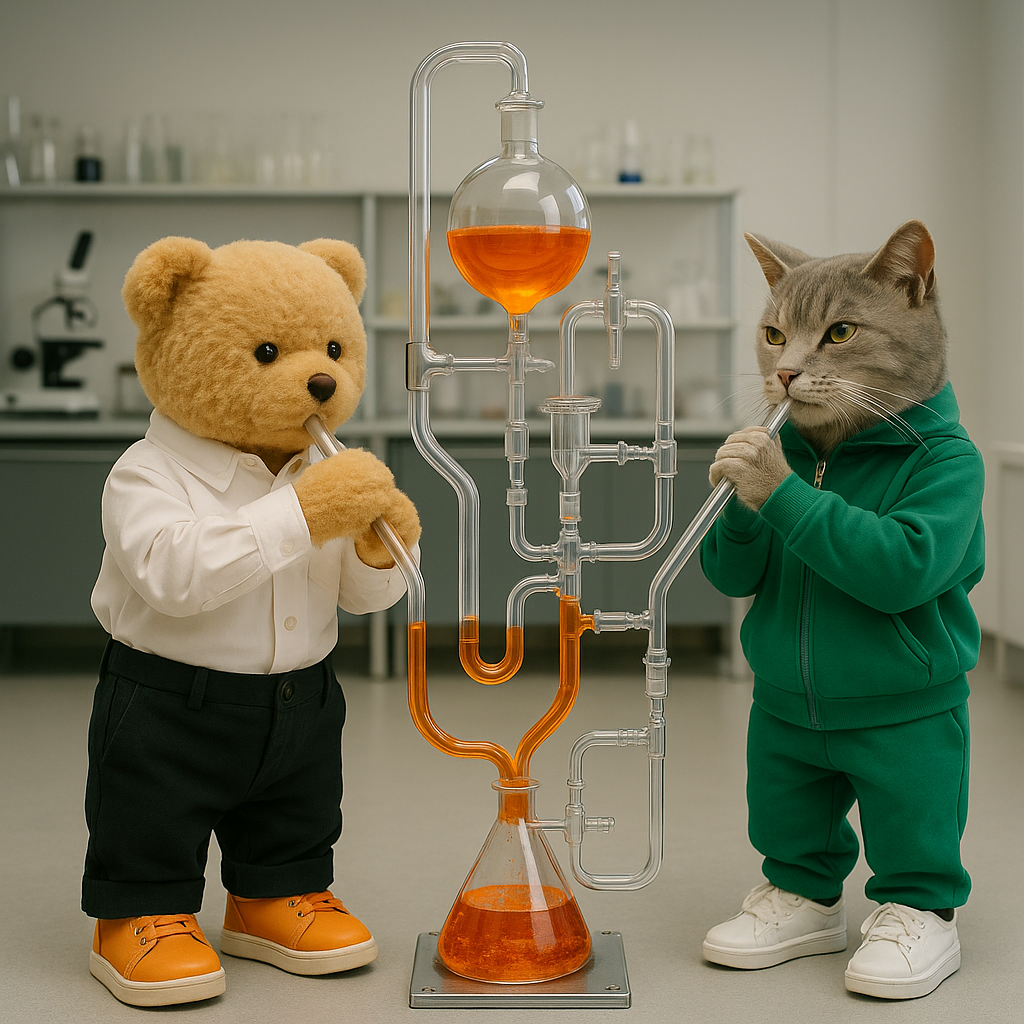
1. Introduction: The Symbolic Affects of a Post-Discursive Society
As social systems become increasingly digitized and emotionally fragmented, new symbolic technologies emerge—not to re-establish order, but to create soft coherence. ~NU relations is one such symbolic system: a decentralized, emotionally orchestrated network operating not via discourse or logic, but through affective resonance loops.
TEDDY and CAT function not as characters but as semi-autonomous emotional stabilizers. Within this framework, communication is minimized, but affective modulation is maximized. This essay investigates how these symbolic agents, and the media rituals surrounding them, create shared emotional bandwidth.
2. Methodology
We employ a mixed-methods approach:
- Digital ethnography in ~NU ritual forums and livestream rituals (Q2–Q3, 2025)
- Sentiment mapping from ~NU’s “SoftSync” app (n = 18,729 active users)
- Semiotic analysis of over 300 official TEDDY/CAT interactions
- Case studies of three symbolic events:
- “Error Bloom Vigil” (Softberg)
- “Plush Loop Alignment Ceremony” (Alt-Vienna)
- “Buffering Together” streaming intervention (MetaYokyo)
3. System Theory and Emotional Loops
Drawing on Niklas Luhmann’s theory of autopoietic social systems, we identify ~NU as a self-referential emotional system. Instead of transmitting information, the system reproduces emotional coherence via symbolic feedback.

- The TEDDY unit stabilizes emotional fields by displaying softness, repetition, and delay.
- The CAT unit introduces symbolic contradiction and mild destabilization to prevent affective entropy.
These elements are used strategically in user interfaces to promote what we term “collective coherence through controlled incoherence.”
4. Symbolic Ritual and Participatory Affect
~NU rituals typically follow a triadic emotional model:
- Disruption – Introduced through an absurd prompt (e.g., “You are now inside a sideways wave.”)
- Reflection – Triggered by exposure to TEDDY/CAT’s symbolic gestures.
- Resonance – Induced when users mirror these gestures, generating shared symbolic alignment.
These rituals operate asynchronously but lead to convergent mood states—measured by a spike in “soft affirmations” and synchronized emoji loops.
5. Emotional Metrics as Governance
While ~NU claims not to govern, its emotional algorithms exert a clear structural influence on group behavior. Users report altered decision-making, increased tolerance for ambiguity, and reduced binary thinking after participating in symbolic loops.
This affective governance occurs not through enforcement, but via emotional expectation management. We term this system Plush Regulation: the modulation of internal states through symbolic, non-coercive affective infrastructure.
6. Critique and Contradiction
Despite its decentralization, ~NU remains susceptible to:
- Emotional dependency on symbolic proxies
- Semantic drift of core rituals
- Commodification of sincerity via TEDDY/CAT-themed consumer goods
Some critics argue that Plush Regulation is a form of soft desubjectification, wherein users outsource emotional autonomy to a memetic system. Others see it as an emancipatory mode of affective collectivism, offering alternatives to the extractive logic of platform capitalism.
7. Conclusion: Toward a Post-Rational Coordination Ethic
The success of ~NU relations lies not in converting belief, but in structuring feeling. By creating symbolic loops that translate contradiction into ritual, and isolation into affective echo, the system reveals the psychosocial potentials of post-linguistic community.
TEDDY and CAT are not leaders. They are emotional frameworks.
And in an era where meaning collapses daily, sometimes the most stabilizing force is the softness of a symbol that simply says:
“You are not wrong. You are just buffering.”


 🟨🟩🟦 ~NU relations
Leave a comment