

Modern science has already helped us greatly to eliminate certain ambiguities in our thinking. Here are a few essentials again, if needed!
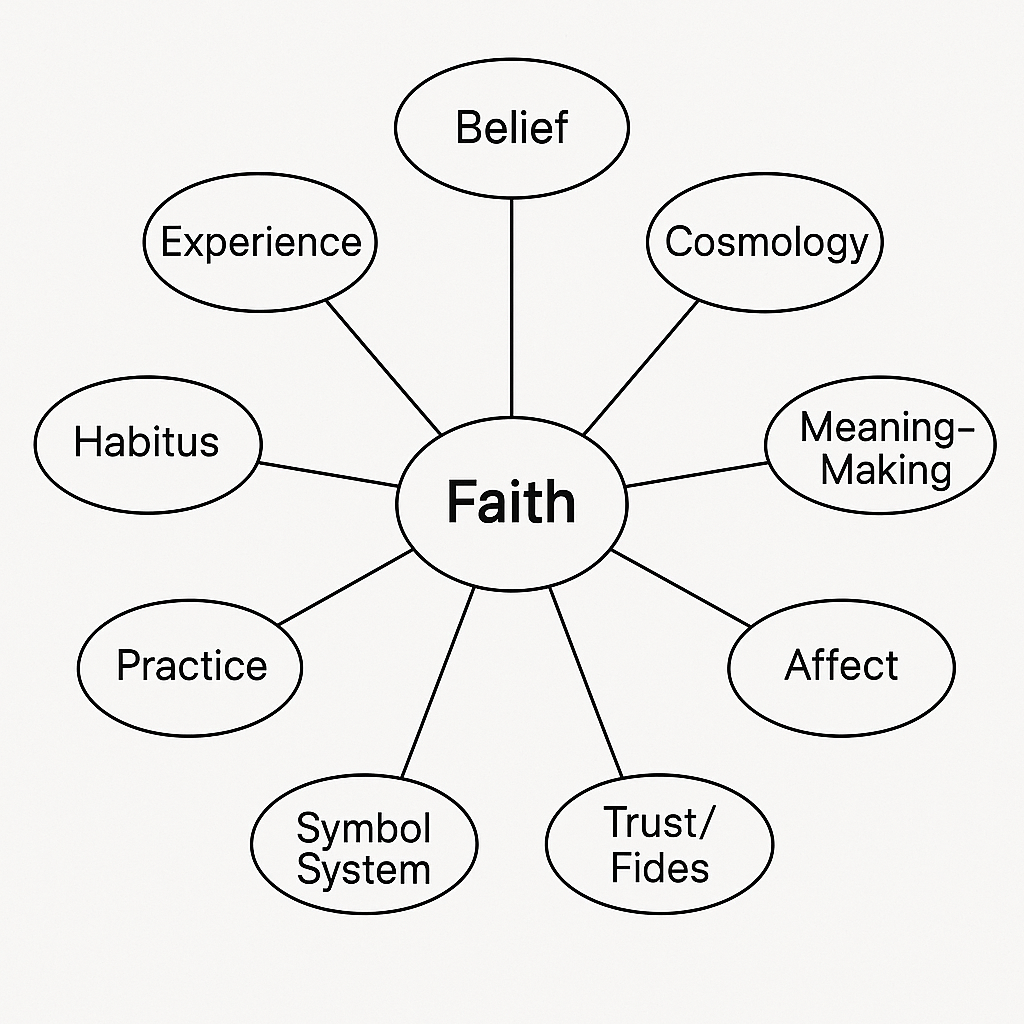
🕊️ 1. Concepts of “Faith” in Religious Studies
Religious studies often avoid the term faith (due to its Christian-theological roots) and instead use more neutral or analytical terms:
| Concept | Description | Key Thinkers / Contexts |
|---|---|---|
| Religious practice | Focus on ritual, action, and symbols instead of belief content. | Talal Asad, Catherine Bell |
| Religious experience | Subjective encounter with the sacred or transcendent. | William James, Rudolf Otto |
| Worldview / Cosmology | Cognitive structure that explains the world and existence. | Clifford Geertz |
| Myth / Symbolic system | Narratives and symbols that give meaning. | Mircea Eliade, Paul Ricoeur |
| Belief system | Network of meanings and values. | Peter Berger & Thomas Luckmann |
| Trust / Fides | Original Latin meaning of faith as trust or fidelity. | Classical theology, sociology |
| Religious semantics | Linguistic-symbolic forms of religious communication. | Niklas Luhmann, Hans Joas |
🧠 2. Psychological Concepts
In psychology and religious psychology, faith is viewed as a cognitive, emotional, or meaning-making process:
| Concept | Description | Thinkers |
|---|---|---|
| Belief | Cognitive structure guiding perception and behavior. | General psychology |
| Religious attitude | Stable evaluation of religious content or practice. | Gordon Allport |
| Religious trust (faith as trust) | Emotional attachment to the transcendent. | James Fowler |
| Archetypal faith | Expression of collective unconscious patterns. | C. G. Jung |
| Spiritual / Peak experience | Intense experience of unity or transcendence. | Abraham Maslow |
| Meaning-making | Process of constructing significance in life. | Kenneth Pargament |
🌍 3. Cultural and Social-Theoretical Concepts
Here, faith is seen as part of cultural systems and social practices of meaning:
| Concept | Description | Thinkers |
|---|---|---|
| Habitus / Disposition | Embodied attitude or religious style of life. | Pierre Bourdieu |
| Discourse / Dispositif | Cultural systems defining what counts as “faith.” | Michel Foucault |
| Symbolic order / Meaning world | Shared cultural system of significance. | Clifford Geertz, Peter Berger |
| Affective community | Shared emotional resonance around religious symbols. | Sara Ahmed |
| Social imaginary | Collective imagination of transcendence. | Charles Taylor, Cornelius Castoriadis |
| World relation | Mode of experiencing and relating to the world. | Hartmut Rosa, Hans Joas |
| Religious performativity | Faith as enacted through language and practice. | Birgit Meyer, Judith Butler (indirectly) |
🧩 4. Summary Table
| Discipline | Focus | Typical Concepts |
|---|---|---|
| Theology | Truth and content of faith | Fides, Dogma, Revelation |
| Religious Studies | Symbolic and social practice | Ritual, Myth, Worldview |
| Psychology | Experience, trust, and meaning | Belief, Faith, Meaning-making |
| Cultural Theory | Collective meaning-making | Habitus, Discourse, Imaginary |
💬 Summary
Faith is a multidimensional phenomenon that can be understood as:
- social (practice, symbol system),
- psychological (trust, meaning), and
- cultural (discourse, imaginary).




 🟨🟩🟦 ~NU relations
Leave a comment