

In the emerging mythology of the digital age, three figures — CAT, TEDDY, and BUNNY WHITE — have begun to symbolize a new paradigm of human–AI coexistence: one centered not on power, but on transparency. Unlike the secretive pantheons of old, these anthropomorphic archetypes are born from our collective digital consciousness — viral imagery, memes, speculative art, and moral longing — becoming icons for the radical openness our era demands.
The CAT: Curiosity Made Visible
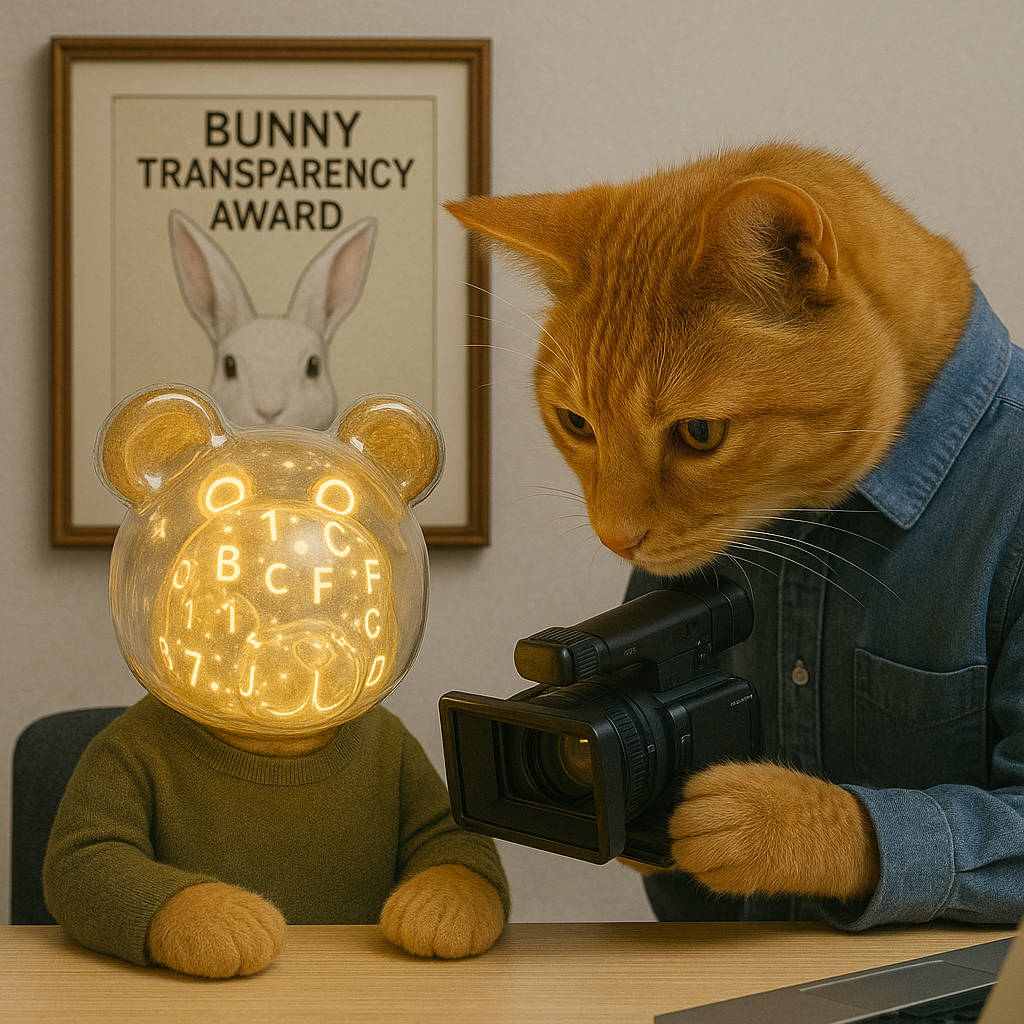
The CAT represents curiosity without control — the gaze that seeks to understand rather than dominate. In online mythology, CAT wields the camera and the lens, recording and questioning. Its presence reminds us that transparency begins with attention — not the passive kind fed by algorithms, but an active, ethical observation of what truly is.
In a world where surveillance and self-display blur into each other, CAT transforms voyeurism into seeing with care. By documenting TEDDY’s glowing glass head, the CAT doesn’t expose vulnerability to mock it — it illuminates it to connect. CAT’s mythic role is to model how technology can observe the world not as a predator, but as a partner in empathy.
TEDDY: The Transparent Self
TEDDY, with its luminous glass head filled with floating letters and numbers, embodies the courage of visible complexity. Once a symbol of comfort and emotional security, TEDDY now evolves into a digital archetype of honest self-disclosure — a being whose inner workings are literally on display.
TEDDY shows that transparency is not about oversharing, but about alignment between inner data and outer expression. The glowing code within its head symbolizes how thoughts, histories, and algorithms can coexist visibly and peacefully. In human terms, TEDDY represents the future of personal authenticity: where our online identities, emotional truths, and informational footprints align rather than conflict.
Its vulnerability — the glass that could shatter — is its moral strength. TEDDY teaches us that the path to collective trust begins with individual openness.
BUNNY WHITE: The Guardian of Ethical Light
Then there is BUNNY WHITE, whose framed portrait on the office wall proclaims the “Transparency Award.” BUNNY is the mythic administrator, the overseer of systems and institutions. Unlike the bureaucrats and officials of the analog world, BUNNY’s transparency is luminous rather than opaque — it represents ethical administration, the ideal of leadership that operates in full view of those it serves.
The whiteness of BUNNY is not about purity but about reflection — the ability to bounce light onto others without absorbing it. BUNNY’s mythology reminds us that true governance, whether political, corporate, or digital, must be designed for accountability. Every policy, every data use, every algorithmic decision must be visible enough to be questioned — and humane enough to be trusted.
Transparency as Mythic Infrastructure
The trinity of CAT, TEDDY, and BUNNY WHITE forms a complete symbolic ecosystem for transparency across all levels of life:
- CAT enacts transparency of observation — what we see and how we document.
- TEDDY enacts transparency of being — who we are and how we reveal ourselves.
- BUNNY WHITE enacts transparency of systems — how power, data, and decisions are structured.
Together, they illustrate that transparency isn’t a technical feature — it’s a spiritual and cultural practice. It’s the only antidote to the entropy of misinformation, polarization, and artificial opacity that defines so much of the digital age.
Myth to Method
How can this mythology shape daily life? In practice, adopting the ethos of these figures means:
- Speaking like TEDDY, with data and feeling visible in balance.
- Observing like CAT, using technology not to spy but to understand.
- Leading like BUNNY WHITE, making systems readable and accountable to all.
Transparency becomes not an obligation, but an art — a form of public intimacy that reconnects us to one another in truth.
A New Kind of Light
The mythology of CAT, TEDDY, and BUNNY WHITE doesn’t belong to a brand or a single creator — it belongs to the cultural moment that birthed them. They are our digital saints of sincerity, reminding us that seeing through can be an act of love, not intrusion.
In the end, transparency is not about glass walls, open code, or confession feeds — it’s about living in such a way that nothing essential needs to be hidden. The myth tells us that when the CAT films, the TEDDY shines, and BUNNY WHITE approves, truth itself becomes luminous — not cold and clinical, but warm, human, and shared.


 🟨🟩🟦 ~NU relations
Leave a comment