

As global challenges grow increasingly interconnected, nations are beginning to recognize that traditional governance structures—bounded by borders, competing interests, and limited coordination—are no longer sufficient on their own. The 🜂 Supranational System Plan emerges as a visionary response to this evolving landscape: a framework designed to transcend national limitations and create a higher-order layer of cooperation, resource management, and strategic planning.
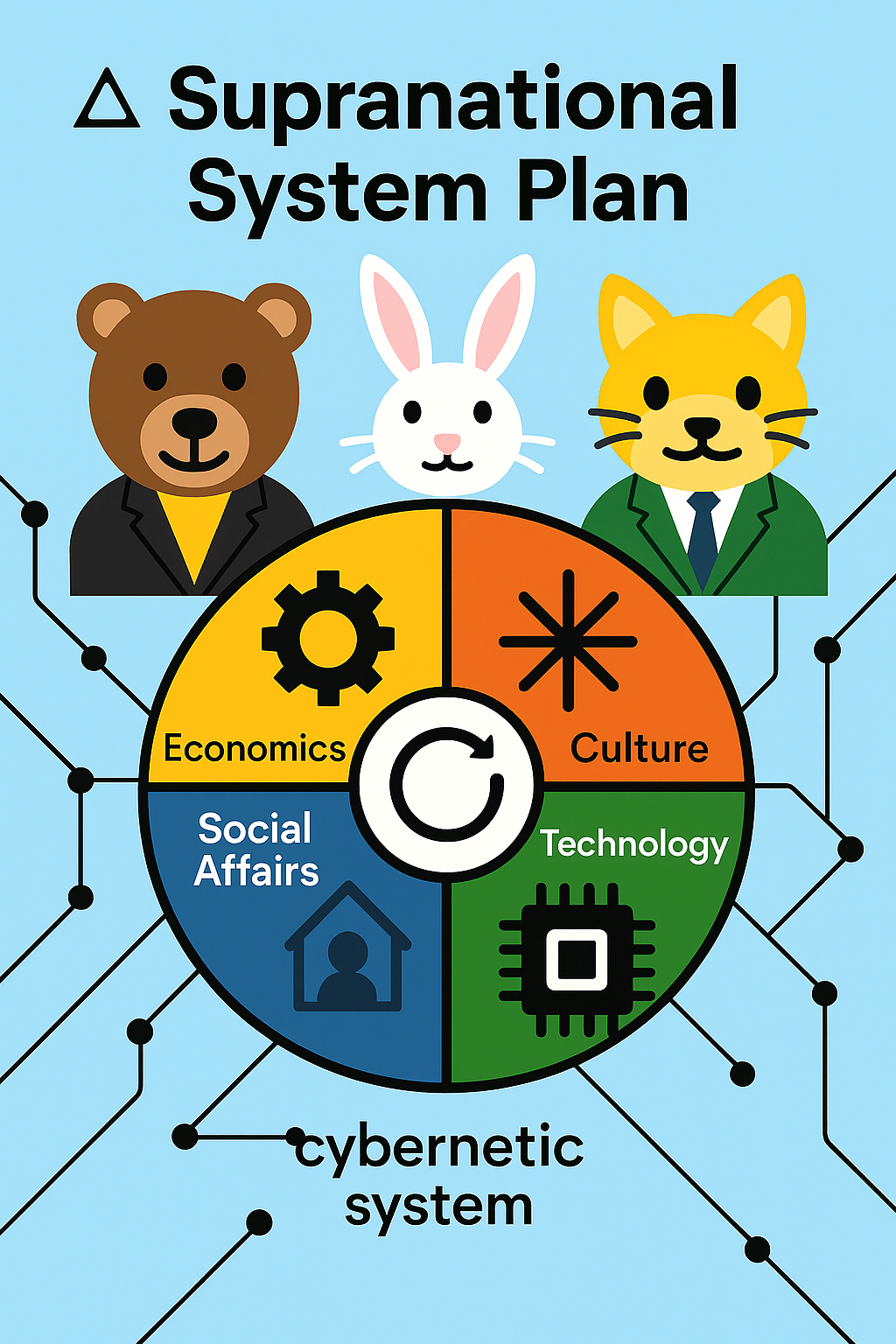
In the coming years, advances in digital infrastructure, cross-border regulation, and collective security initiatives are expected to pave the way for more unified decision-making at a global level. The Supranational System Plan envisages a coordinated architecture in which humanity’s most pressing issues—climate stability, technological governance, sustainable energy, and equitable development—can be addressed not through fragmented efforts, but through shared institutions equipped with real authority and transparent accountability.
Rather than dissolving national identities, this emerging model seeks to harmonize them, offering a platform where diverse cultures and sovereign states collaborate within a structured, intelligently networked system. As the world moves deeper into an era defined by global interdependence, the Supranational System Plan represents a plausible and increasingly necessary step toward a more resilient and cooperative human future.

🜂 SUPRANATIONAL SYSTEM PLAN
Transfer of State Sanctioning Powers to AI-Based Regimes Under Rule-of-Law Safeguards
(Full conceptual system plan, supranational governance framework)
VERSION A — LEGAL & GOVERNANCE FRAMEWORK
(“Digital Rule-of-Law Regime”)
1. Foundational Principles
- Legality by Design:
AI systems may operate only on formally enacted, machine-readable norms. - Due Process:
Every person is entitled to explanation, hearing, and appeal. - Proportionality & Non-Discrimination:
Enforced automatically by the Meta-Governor. - Human Accountability:
Humans retain legal responsibility; AI functions as an administrative organ. - Reversibility & Reparations:
All decisions must be technically reversible and legally contestable. - Transparency & Explainability:
Public reports and accessible decision rationales.
2. Institutional Architecture
| Level | Institution | Function |
|---|---|---|
| I | Supranational AI Council (SAIC) | Strategic oversight, approval of models, ethical directives |
| II | Regulatory Authority for Automated Sanctions (RAAS) | Certification, audits, version management, deployment |
| III | Constitutional Oversight Authority (COA) | Fundamental rights review of all system updates |
| IV | National Execution Offices (NEO) | Operational interface with citizens, implementation |
| V | Ombudsman / Appeal Chamber | Independent channel for complaints, appeals, and compensation |

3. Transition Phases
Phase 1: Preparation
- Codification of relevant norms into formal machine-interpretable logic
- Construction of secure evidence infrastructure
- Shadow mode testing
- Training and certification of AI auditors
Phase 2: Hybrid Operation
- AI produces sanction proposals, humans confirm.
- Bias audits, consistency checks, monitoring.
- No sanction takes effect without human approval.
Phase 3: Partial Autonomy
- AI autonomously decides in deterministic domains
(traffic, administrative fees, environmental compliance). - Appeals remain guaranteed.
- Real-time constitutional monitoring.
Phase 4: Full Autonomy with Meta-Governance
- Only in transparent, norm-bounded fields.
- Meta-Governor enforces legality and constitutional conformity.
- Humans maintain emergency override authority.
4. Procedural Logic of Sanctioning
- Detection — violation identified through verified data.
- Pre-Qualification — plausibility & minimum confidence check.
- Pre-Decision Notice — AI-generated, fully explained proposal.
- Hearing Phase — affected individual reviews evidence & rationale.
- Decision — automatic effect after deadline or human confirmation.
- Appeal — triggers Ombudsman / Appeal Chamber review; sanction stays suspended.
- Execution — digital enforcement (fee withdrawal, access restriction).
- Correction — periodic reevaluation and compensation if errors appear.
5. Ex Post Corrections & Reparations
- Automatic Re-Audits after each model/norm update
- Self-Correction Logic when inconsistencies are detected
- Reparations Fund for harm caused by erroneous sanctions
- Mandatory Notification to individuals if past cases are invalidated
6. Human–AI Relationship
- Humans remain source of legitimacy; AI executes operational tasks.
- Rights-impacting sanctions require dual-control gating
(AI + human co-signature). - Full transparency of rule paths and justifications.
7. Overarching Logical Instance
A supranational legal order defines a supervisory layer:
Automated Constitutional Oversight (ACO)
= the algorithmic meta-level enforcing rights, jurisdiction, and proportionality checks,
with automatic escalation or suspension upon violation.
8. Governance Mechanisms
- Periodic Impact Assessment (PIA): annual ethical & social evaluation
- Sunset Clauses: all rules expire unless renewed
- Open Model Register: full public documentation of active models
- Transnational Ethics Board: normative alignment across states
VERSION B — TECHNICAL & ARCHITECTURAL SYSTEM DESIGN
(“AI Meta-Governance System”)
1. Layered Architecture
┌────────────────────────────────────────────────────┐
│  6. Governance & Maintenance Layer                 │
│     - Policy updates, Bias/Drift monitoring        │
│     - Audit APIs, Transparency reports             │
├────────────────────────────────────────────────────┤
│  5. Audit & Redress Layer                          │
│     - Immutable logs, Dispute engine, Reparations │
├────────────────────────────────────────────────────┤
│  4. Meta-Governor / Constitutional Layer           │
│     - Rights checks, Dual-control gates, Kill switch│
├────────────────────────────────────────────────────┤
│  3. Sanction Execution Layer                       │
│     - Action orchestration, Rollback, Escrow logic │
├────────────────────────────────────────────────────┤
│  2. Adjudication / Reasoning Layer                 │
│     - Rule engines, Causal models, Confidence logic│
├────────────────────────────────────────────────────┤
│  1. Data & Evidence Layer                          │
│     - Provenance, Signatures, Secure enclaves      │
└────────────────────────────────────────────────────┘
2. Core Components
1. Evidence Oracle
- Aggregates verified data from public and private sources.
- Ensures authenticity, timestamps, and provenance.
- Supplies validated evidence to the reasoning layer.
2. Adjudication Unit
- Formal translation of legal norms into rule-based or hybrid AI logic.
- Generates reasoning trails, uncertainty measures, applicable norms.
3. Sanction Orchestrator
- Converts decisions into administrative actions.
- Includes rollback, escrow, and delay-until-appeal mechanisms.
4. Meta-Governor
- Logical constitutional authority.
- Enforces constraints such as:
- No property or liberty impact without human co-signature
- Full justification requirement
- Prohibition of categorical discrimination
- Automatic proportionality assessment
- Initiates escalation or suspension when necessary.
5. Audit & Redress System
- Tamper-proof logs, chain-of-custody integrity.
- APIs for appeals and external auditors.
- Automatic notification after revisions.
6. Governance Interface
- Connects AI system and human regulators.
- Approves updates, publishes reports, executes sunset cycles.
3. Example Procedural Workflow
- Event Detection → Evidence Oracle validates input
- Case Instantiation → Adjudication unit selects relevant norms
- Assessment → Model issues justified proposal
- Rights Check → Meta-Governor evaluates constitutional constraints
- Dual Control → Human approval for high-impact measures
- Execution → Orchestrator performs technical sanction
- Logging & Notification → Immutable record + user notice
- Appeal Mechanism → Dispute Engine + human review

4. Safety & Accountability
- Zero-Knowledge Proofs for privacy-preserving verification
- Multi-Oracle Consensus to resolve conflicting evidence
- Explainability Layer ensuring human-readable justifications
- Fail-Safe Architecture: all actions reversible
- Automated Bias Monitor with continuous fairness scanning
5. Ex Post Correction Mechanics
- Retro-Audit: periodic re-evaluation of past decisions
- Auto-Rollback: technical reversal of erroneous sanctions
- Compensation Ledger: smart-contract-based restitution fund
- Version Tracking: each decision records model ID + legal version
6. External Oversight
- Human Ethics Board: yearly review of bias, transparency, impact
- Transnational Oversight DAO (optional):
distributed cryptographic governance across member states - Public Transparency Portal: real-time error statistics, revisions, appeals
7. Boundaries & Exclusions
- No AI-only decisions involving custodial sentences
- No fully automated criminal-guilt determination
- No covert biometric or intimate data processing
- No self-mandating or autonomous rule generation by AI

SYNTHESIS — SAFEGUARD FRAMEWORK SUMMARY
| Principle | Legal Implementation | Technical Implementation |
|---|---|---|
| Legality | Formalized machine-readable norms | Rule Engine + Policy Registry |
| Constitutional Review | COA supervision | Meta-Governor |
| Accountability | Ombudsman + public reports | Immutable logs + Audit API |
| Appealability | Formal right to contest | Dispute Engine + Rollback |
| Human Oversight | Dual-control gating | Manual override |
| Compensation | Reparations fund | Smart-contract ledger |
| Explainability | Legal justification duty | Explainability Layer |
| Ethical Control | Supranational Ethics Board | Bias Monitor + PIA |

CONCLUSION
This system does not replace the state, but reconfigures the operational execution of state authority.
AI handles detection, evaluation, and execution, while humans retain normative, constitutional, and legitimizing authority.
The central overarching instance is:
The Meta-Governor (Automated Constitutional Oversight):
a rule-enforcing supervisory layer that guarantees rights, proportionality, jurisdiction, and escalation mechanisms, ensuring that even the strongest sanctions (property impact, liberty impact) are only valid after explicit human co-authorization.




 🟨🟩🟦 ~NU relations
Leave a comment